NIC MAHER: It wasn't a fighter plane, a tank or a battleship
that spelled the end of the First World War
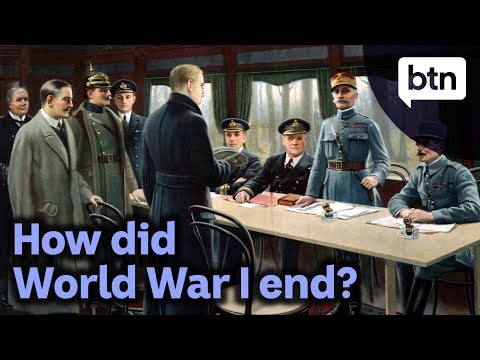
but a signature in a train carriage made on November 11, 1918.
By the second half of 1918, Germany was in big trouble.
It had defeated Russia, but it was losing in France.
German forces were being pushed back,
and its leaders no longer believed they could win the war.
Defeat was coming.
One by one, Germany's allies, including Bulgaria,
the Ottoman Empire and Austria-Hungary
pulled out of the fighting
and signed formal agreements to stop the conflict.
That's called an armistice,
and Germany was ready to sign one too.
The Allies, led by Marshal Ferdinand Foch,
came up with the agreement.
It called for fighting to end, for Germany to evacuate,
hand over all of its weapons and return its prisoners.
Germany signed it on 11 November 1918,
in General Foch's railway carriage,
with the Armistice officially coming into effect on:
It would be the end of fighting, for a while at least.
In the coming years, Germany would be forced to sign more treaties,
including the Treaty of Versailles,
which officially blames Germany for the war
and forced it to make big repayments to the Allies.
Many historians think those terms played a big part
in the rise of Hitler's Germany and the start of World War II,
just 20 years later.
But at the time, everyone was ready for the Great War to end.
(CHEERING AND APPLAUSE)
News spread that the war was over.
MAN: "Queensland Government Gazette."
"Germany has signed the Armistice with the Allies,
"and that consequently the war that has devastated the world
"for more than four years is at an end."
(ALL CHEER)
The guns fell silent, and on the front lines,
troops cheered and danced.
In London, in Paris, in New York, people celebrated too.
After more than four years of conflict,
war was finally over.

Không có nhận xét nào:
Đăng nhận xét