"4...3...2...1" "T-Zero!"
This is the Operation Ivy nuclear test in 1952.
And this is using a level for really nice masonry on your fallout shelter.
It's from 1960's Walt Builds a Family Fallout Shelter.
The idea was that you'd deck out your basement so you'd be safe when the bomb went off
and this happened.
"Well, this finishes my fallout shelter."
Yes, Walt is smoking a pipe.
The Federal agency that made this film, and the agencies that preceded it,
helped craft the domestic response to nuclear armageddon in the 1950s and '60s.
Fallout shelters like these were an inescapable part of Cold War culture in America, promising
a place to hide from the radioactive fallout.
Federal agencies promoted them, Presidents advocated them, and the effects are still
around today.
This is the garage in my urban, Washington DC apartment building.
And it's a designated fallout shelter.
That's the sign.
Right here.
How am I pointing?
There were almost a thousand designated fallout shelters in Washington, DC, and they're
a reminder of the fallout shelter boom, both in public fallout shelters like this one,
and in private ones where people gave a lot of tours, like this one.
"Well folks, I'm glad you could come down to see my fallout shelter.
Just finished painting it last night."
Fallout culture wasn't just awkward, though it was that.
"Say, isn't this nice?"
It poses some questions: like where did this stuff come from?
And were duck and cover drills, and desk crouching,
and canned water, and fallout shelters
worth the Cold War paranoia they helped fuel?
How did this happen?
"Fortunately, there are means of protecting ourselves."
And would any of it have actually worked?
"Folks, here is a message from the honorable Leo A. Hoegh, director of Office of Civil
and Defense Mobilization."
"You've just seen how Walt has built a family fallout shelter in his own home."
"No home in America is modern without a family fallout shelter.
This is the nuclear age."
To understand how we reached that vision of bunkered down modernity, you have to understand
the timeline of Civil Defense.
The 1950s and early 60s weren't just one period — they were a few different eras
that we mush together because of Cold War kitsch.
Timing matters.
In 1933, Franklin Roosevelt created a pre-nuclear council that coordinated some emergency programs.
As World War II heated up, Civil Defense grew, turning into the Office of Civil Defense Planning.
In 1949, civil defense became more urgent when the Soviet Union tested a nuclear bomb.
The stakes became higher.
So after some more bureaucratic shifts, Congress created the Federal Civil Defense Administration,
which was meant to help guide the states in defense at home.
And that's the name you see at the beginning of 1951's "Duck and Cover."
"There was a turtle by the name of Bert, and Bert the Turtle was very alert.
When danger threatened him he never got hurt, he knew just what to do.
He ducked...and covered...ducked...and covered…"
As stupid as that seems, a movie about a nuclear paranoiac turtle named Bert wasn't that
foolish.
Ducking and covering would help provide some protection.
At the time, the Soviet nuclear threat was terrifying but their bomb was relatively limited
in range and would be dropped by a plane, which meant we'd see them coming.
"You may be in your schoolyard playing when the signal comes."
Running inside might make a difference.
Or even ducking and covering.
But that explosion in the beginning of this video?
That actually came after "Duck and Cover."
It's from the United States' 1952 test of the hydrogen bomb, which was more powerful
than any weapon that came before it.
"Remember those final last seconds?
"Fiver, four, three, two, one, t-zero."
"This is the largest fireball ever produced.
At its maximum limit it measures about three and one quarters mile in diameter….the fireball
alone would engulf about one quarter of the island of Manhattan."
"Later figures put the Mike yield at ten megatons, or about 10,000 kilotons.
This means there was more energy released in this one shot, roughly 10 times more than
in all previous atomic blasts combined, including probably those of Russian origin.
Or to put it another way, four times more power in this one shot than in all the high
explosives dropped by the entire Anglo-American air force on Germany and the occupied countries
during the last war."
Then the Soviets claimed to have tested their own hydrogen bomb in 1953,
and "Duck and Cover" became outdated.
The FCDA questioned its own relevance.
Coupled with the Eisenhower Administration's preference for evacuation and military deterrence,
the organization's head briefly considered its elimination.
But another hydrogen bomb test in 1954 revealed a greater threat.
"The width of the fireball at this time about three seconds after detonation was four
miles."
But it was the fallout Americans noticed.
"It is now known that fallout from the larger Castle shots blanketed areas of more than
5,000 square miles with radioactive material that would have been lethal to unprotected
personnel."
In America, this new awareness of fallout forced Civil Defense to pivot.
"You need to know about fallout."
"What is this fallout anyhow?
Just bits of radioactive matter fall out of the mushroom cloud of the nuclear explosion
and settle on the ground."
The FCDA and subsequent offices of civil defense recommended finding refuge.
"The goal is adequate fallout shelter space for every man, woman, and child."
They started with recommendations to evacuate to public fallout shelters.
But the 1957 Soviet development of an intercontinental ballistic missile made even evacuation...outdated.
Unlike in the era of planes, there'd be little warning of a strike.
There were big fallout shelter proposals.
But the Eisenhower administration balked at charts like this one from 1957's Gaither
Report.
The sweet spot for fallout protection, seen here, would cost an untenable $25 billion.
The government didn't want to pay that, but they also couldn't kill civil defense.
In 1958, Eisenhower's National Shelter Policy was simple: do it yourself, because we don't
want to bother.
The result?
Telling people to build their own fallout shelters, like in this 1960 film.
"We all have a responsibility to help."
"Every member of the family should understand radioactive fallout and how to protect himself
from it."
That paired with those aw-shucks-nuclear-devastation-of-everything-we-know-and-love preparation videos, like Walt's.
"If we should ever have a nuclear war, we could have a heavy fallout even though we
weren't anywheres near the target area."
But it took one last push to get us here.
"From the White House in Washington DC, we bring you an address from the President
of the United States, John F. Kennedy."
"An attack upon that city will be regarded as an attack upon us all."
John F. Kennedy's 1961 speech about the Soviet blockade of West Berlin intensified
the Cold War.
Military growth was a goal, but the speech was also a platform to announce a shift in
civil defense policy.
"Tomorrow I am requesting of the Congress new funds for the following immediate objectives."
"To identify and mark space in existing structures, public and private, that could
be used for fallout shelters in case of attack…." Kennedy requested the civil defense budget
increase to about $207 million, which was much less than the $25 billion recommended
in the Gaither Report.
But it did mark a change in emphasis.
It was part preparation, part message to the Soviet Union that the US could survive an
attack.
He reorganized the agency yet again.
The government had stocked a number of public fallout shelters, though the effort was scattershot.
Some people had made their own home versions.
"Then you can rest assured that no matter what the fallout threat in the future, you
and your family will be ready for it."
So would any of this have actually worked?
Let's go upstairs.
In 1961, the Soviets tested Tsar Bomba, the largest bomb...ever.
It was more than 50 megatons.
Historian Alex Wellerstein created a tool called Nuke Map that lets you simulate what
historical nuclear bombs would look like had they detonated over various cities.
Put in Tsar Bomba and Washington DC, and you get this.
The entire city would be gone, destroyed.
The initial blast, the subsequent firestorm...forget about radioactive fallout.
That fallout shelter in my basement would not exist.
All those urban fallout shelters would probably collapse in a massive nuclear exchange.
And beyond those cities?
"More than 100 million people living well beyond the destructive range of blast and
heat could be subjected to dangerous or deadly amounts of radiation from fallout."
Walt out in the suburbs might survive in his fallout shelter.
But he'd emerge in a country where all the major metropolitan areas were husks.
This chart shows the decline in civil defense spending during the Johnson administration,
due both to JFK's assassination and the buildup in Vietnam.
Civil defense agencies limped along with enough money to survive and run programs, publish
pamphlets, and make some videos.
But they didn't make a meaningful commitment to a fallout-sheltered nation.
The fallout shelter was a place to hide from the bomb, and radioactivity.
But it was also a place to hide from the truth that there was no good plan.
There were only different ways to wait.
"This is the nuclear age."
So if hanging out with Bert the turtle didn't depress you
too much, we've made another video
where I watch the entirety of "Duck and Cover,
provide some additional research
and an opportunity to laugh at those kids diving into the floor.
 For more infomation >> Jackie Chan & Olivia Munn Answer Martial Arts Questions From Twitter | Tech Support | WIRED - Duration: 4:26.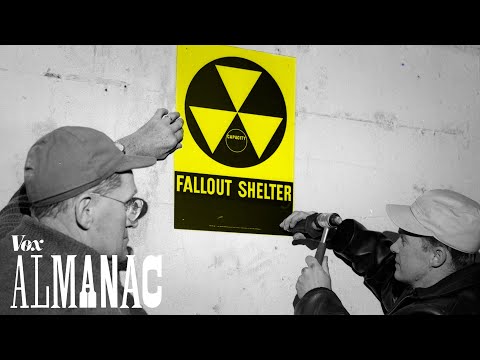
 For more infomation >> Cláudia Gadelha vs Jéssica Andrade | Highlights | UFC FIGHT NIGHT - Duration: 3:52.
 For more infomation >> 2 News at 6 p.m. Weather - Duration: 3:45.

Không có nhận xét nào:
Đăng nhận xét