>> Well, hi everyone.
Glad to see a full room.
I am Stephanie Craft, University of Illinois and I teach
in the College of Media.
Specifically, I teach in the journalism department there.
I teach things like journalism history, journalism ethics.
I teach in communication theory.
And I have taught some classes in what we call news literacy
which is-- we'll talk a little more about that later.
It's kind of a branch so to speak
or like a subcategory kind of a media literacy.
So it's especially-- a lot of people talking
about news literacy these days for some obvious reasons
that I'm sure we can all share and we'll share about.
So, what I want to talk about today is kind of where some
of those news literacy, fake news, ethical issues,
responsibilities of news, consumers as well
as journalists, all kind of meshed together.
So, let's see if my little clicker thing works.
I don't know really where I'm pointing it.
Am I pointing it there?
Oh it makes a ding, that's nice but it's not moving.
Hmm, well, I'm just going to talk for--
the next slide is really funny so let's just prepare ourselves
for that if it goes there or maybe-- ah!
See, as promised.
I think this probably reflects how a lot of us might feel right
about now that I really try hard to be an informed consumer
but how do I do that and yet still keep all of my hair,
where it's not falling all out of my head.
So right, we're going to be thinking about why is it
that way, why is it so hard to be well-informed
and maintain some semblance of like normal levels of sanity?
OK. Am I not doing this right?
>> No, it's not you.
It's our equipment.
Let me know when you want me to advance.
>> Oh, you poor thing.
>> That's OK--
>> OK, it's going to be a lot of advancing.
>> That's fine.
>> You might need a chair.
OK. All right.
So let's go to the-- let's go pass the-- yeah.
OK. So here are questions to ponder specifically
around fake news, right?
So, is fake news new?
I think you're going to probably guess the answer to that is no
but don't want to give too much delay.
Yup. How is fake news fake?
And by what I mean-- what I mean there is what is it
about fake news that makes it seem like this own--
its own separate category of thing.
OK, especially if it isn't new
which we'll find out in a moment.
Why? This kind of refers to the title we talked,
why is fake news so alerting, right?
Like why do people get kind of swept up in it, why does it seem
to have kind of taken over a little bit?
Whose problem is fake news and what can we do about it?
OK, so those are sort of our guiding questions here.
I think I'm going to address all of them and if I don't,
I'm going to count on you to tell me where I messed up.
OK, next one.
All right, so fakery then and now.
Now it might be a little hard to see this but that is a picture
of a fairly famous fire in London in the 19th century, OK.
And there's a little snippet of a quote there
from the correspondent who wrote about that fire for a newspaper
in Berlin, obviously it's translated from the German.
Those of you in the room who might speaks
in German can tell me-- hold, don't tell me yet--
can tell me what the top line means.
But let's look and see what the correspondent has said
about this fire.
"I went to the scene today and it's a terrible sight.
One sees the burned buildings," you know, like oh it's
so terrible and this is an artist rendering of it.
Does anybody in here speak German?
He'll never know.
[ Laughter ]
[ Inaudible Remark ]
What that means at the top is essentially the
fake correspondent.
In the 19th century, it was pretty common actually for,
especially, foreign correspondents to be kind
of making up their stories, OK.
So, let's think about-- we're going to talk about him,
the fake correspondent more, OK.
But let's just ponder for a second what that means.
This guy writes for a Berlin newspaper,
is writing about a fire in London,
is saying that he went there and this is a person
who never crossed the English Channel once in his life.
He's never been to London, much less to cover that fire.
So how did he do it, why did he do it?
Well, it's not like the fire didn't happen
so it's not fake like that, OK.
It's not like it wasn't destructive in that way, right.
But what he did was he sort of looked at all the coverage
of people who have seen the fire, he picked the best parts,
right, and then he embellished and created characters
and created like someone who took him to the scene
of the fire, sort of escorted him there so he makes
up some quotes and stuff like that.
So, is that story fake or not, right?
I mean the story, the actual incident, not fake?
What he reported about it, not fake.
Some of the parts of it, definitely fake, right?
So, but no one seemed to care in the 19th century
for some reason, right?
This was a-- not a-- an unusual practice
of just this one newspaper.
OK, next one.
Then we've got-- go ahead.
The modern day example is the guy
who I'm calling the broke consultant-wannabe
who created this story that some of you might remember and I--
again, the resolution isn't great here.
That is an image of a guy standing by some things
that are labeled ballot boxes.
Now, some of you may remember during the 2016 campaign,
there was this kind of brief controversy
about this news story that said, "Tens of thousands
of fraudulent Clinton votes found in Ohio warehouse."
And this was the picture.
Did anybody see this?
You guys remember this from the election, you remember it too.
OK. So, at least we know it's not fake that I've made it up.
They've really-- Was it real fake news?
See? It's confusing.
So, this appeared on a site inexplicably,
well we will explain it in a minute,
called the Christian Times.
Now, where does the broke consultant-wannabe come in?
Well, the guy who created this story which, by the way,
100% fake, OK, was a 23-year-old guy, I'm going to guess some
of you can sympathize with this next part,
trying to pay off his student loans
and wanted to make money, right?
And so he's thinking to himself, "Well, I can buy a domain."
He buys the Christian Times, when it had been sort of created
by someone not used anymore, right?
He buys it for $5, OK?
And then he decides, well, this is going to be my platform
to create news and make a lot of money off the advertising
that I can put on this site, OK.
And so, in order to make enough money off the advertising,
he's got to have something
that people will want to click on and see.
So he thinks to himself, "Well, what's going on?
What's the narrative going on in the election at this point?"
Well candidate, now President Trump was saying a lot
about a rigged election, right?
He was really concerned telling his supporters,
he thought the election was going to be rigged
that there's no way Clinton would win unless it was rigged
and on and on.
I'm guessing you all remember that too.
And so this guy who is broke who wants to be a consultant
who just is kind of in this for the quick money says,
"You know what, I bet I could create a story around that."
Right? So we have a 19th century example
where someone has taken a real thing, embellished it
and passed it off as news and we've got a similar,
not exactly the same but a similar modern day example
of someone who recognized this kind of a story
like it's not fake, the Trump had made that an issue, right?
It's not fake that people were talking about it, right?
And sort of capitalizes
on something that's just sort of in the air, right?
And makes lot of money.
Now, somebody sort of tracked him down and figured this out
and then he was like whoa, I didn't mean
for it to be all political.
But he made like $500 just like that, doing that.
OK, so ideas for home businesses.
There you go.
All right, next one.
So, let's compare how this worked, right?
And I am indebted, by the way to this German study scholar
at Dartmouth who like kind of pulled the world
about these 19ht century fakers.
Here's what she says about Die unechte Korrespondenz,
that's my German accent.
His readers probably believed him
because his story confirms a lot
of things they already knew, right.
So his story didn't feel fake because it resonated somehow
with what they'd already read about the fire in London,
huge fire, very terrible.
Similarly, that ballot story, that ballot box story,
this is a quote from the guy who created it.
"Trump was saying, rigged election, rigged election.
People were predisposed
to believe Hillary Clinton could not win except by cheating."
So again, he's successful to the extent that he's tapping
into something that people were already talking about
and already sort of think could be true, right?
Interesting similarity.
So, the answer kind of to our first question is fake news not
really new, right?
And there are some interesting stuff about how it works
that we can trace all the way back to the 19th century.
OK, next. Here is an image of a paper, an American paper
from the 19th century, this happened to be one
of the yellow papers, OK.
Look at this front page.
Is this fake news?
Does it look like fake news?
Right? It looks quite sensational, doesn't it?
Right? That was the whole thing about the yellow papers is
that they really dramatize life, OK.
So here, we have, you know, this woman jumping
from the Brooklyn Bridge, we have kind of an artist rendering
of her jumping, right?
We've got kind of a portrait of her and why she did--
oh her money was gone, you know, right?
We've got these really big headlines,
right, all of this stuff.
This stuff is all true, right, but it has this kind
of appealing quality that we want to keep in mind
like about modern day examples of things
that make fake news sort of appealing, alluring, OK.
So, here is our old thing, this is-- this isn't--
this kind of aspect,
the dramatic appearance aspect is not new.
OK, next one.
And then you have this, we've seen this at the supermarket
for a long time, right?
And no one minds.
>> Very funny.
[ Laughter ]
>> Some of us mind, not all of us think about it too much, OK.
Now in case, you know, just to be clear, 100% fake, OK.
Just let's all be on the same page here.
But think about it, people sort of look at this and they get it.
They get that it's like so over the top, of course,
it's supposed to be fake, right?
Isn't it? Nod with me, yes.
Yes. OK. So again, the idea
of something that's just outright made up,
this is not new, right?
And so we are still left with this question, right,
what is new then about this fake news that we saw
so much off during the campaign and really even before that.
But really during the campaign, what is new about it, OK.
So, we're going to talk about four-- oh no.
OK, four things that sort
of make fake news hard to figure out.
I say tricky to tackle here, hard to figure out, OK.
And the first one, let's just pause for a moment.
It-- OK, this seems so weird, I mean counterintuitive
but just bear with me.
I don't know why I'm holding this if it doesn't work.
OK.
[ Laughter ]
>> It's fake news.
>> It's fake news, it's like I'm pretending to have autonomy, OK.
It challenges this either/or idea.
It challenges the idea
that something is either true or false.
Now think about those historical examples, there were parts
of those things that had a little bit
of truth to them, right?
And so, there's something about fake news
that you can't just say it's 100% false
because that doesn't really tell you the whole story.
And to like point out here, something can start
out as a completely satirical kind of weekly world news.
I have Bigfoot's baby, whatever thing and then sort of morphed,
kind of get laundered into a fake news thing that sort
of meant to look like it's not a joke, right?
And so, we can't-- it's tricky to sort of nail fake news
down because it isn't just true or false.
If it were that easy, we wouldn't be here, right?
We wouldn't be here talking about it.
It wouldn't really be worth talking about, OK.
And so, the example here is maybe you recently,
the press secretary got into a little bit of trouble here
with some comments that he made about the holocaust.
This, however, was not one of the comments he made
about the holocaust, OK.
This represents then-- heavily represents a far more extreme
thing that he could have said
about the holocaust but did not, OK.
So, there were issues raised
about how he characterized the use of gas during--
on, you know, German citizens during the holocaust, right?
So there's something truthful here, right?
There's enough of the kind of surface truthiness to it
that then it would be sort of you can see
where maybe initially someone might look at this and sort
of be like, oh really?
Like I heard something
about Spicer saying something about the holocaust.
Is that what he said?
Right. So, we can't just say it's true or false.
Because it is true that Spicer said some things
about the holocaust that were like kind of out there, right?
But he wasn't that far out there, OK?
So that's kind of our number one true/false, either/or not
that black and white, OK.
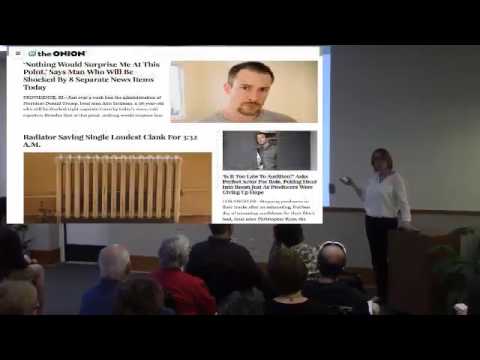
Here's our satirical Onion.
My favorite one here is, "Nothing would surprise me
at this point," says man shocked by everything.
That's how I feel.
Nothing could surprise me anymore.
And I read it, I'm like oh my God.
You know, what now, right?
This may be some of you who lived in older homes going
to appreciate, the radiator, saving loudest clank
for middle of the night, OK.
So these things can start out satirical,
now these are great examples of things that could morph
into a fake news piece but that is instructive too, right?
The Spicer thing works because it really is already
in the news somehow, right?
And then you could see where it could start out as satire
and then sort of bloom into something else.
These other kind of satirical things,
it would be maybe a little bit harder to do but it's
from the show The Onion anyway, OK.
So, these people
at an organization called First Draft have attempted--
OK, and this is going to be hard to read--
have attempted to kind of categorize all the things
that people are calling fake news.
Now, OK, this alone should tell you
that it's not an either/or thing.
It's not either like oh, it's fake news, it's not fake news
because look at all the varieties of it.
People have called stuff fake news, have labeled it fake news
if it was satire like The Onion or if it was just sort
of misleading but maybe the facts
in it weren't exactly wrong, right?
Or maybe, its genuine sources are sort of impersonated,
that's the impostor part.
Like you might have a situation where there are real people kind
of getting misrepresented or quoted
in a different context or something.
Then there's outright fabrication,
just making stuff up, right?
Well, those are four of the seven types like my goodness,
how-- like if there are seven types of things
that get called fake news, we're really
in trouble trying to figure this out.
And then on the bottom, we have things where you could look
at a piece and you could look at the headline or the picture
or something and think, oh my gosh, you know, and click on it
and then you go to the story and it's like, wait,
what does this have to do with the headline, right?
So that false connection, you're sort of getting drawn
in thinking that the story or the picture is going
to tell you one thing and then you get something else.
People have labeled that fake news too.
That might not be how you're defining fake news
but that is how others have done that.
Putting things on a false context, OK,
and then manipulating content.
So, we could sit here for the rest of the time
and actually just come up with examples of all of these things
and some of the other examples that we're looked--
we're going to look at, we could try to kind
of put in the right box.
The point at this moment is just to say, wow,
seven types of misleading content, right?
Again, fake news, it really challenges us
to think beyond either it's fake or it's not.
It might-- How is it fake?
It might be fake in entirely different ways.
One item might be fake in that way, one item might be sort
of fake in this other way.
One item might looked fake but not be fake, right?
All kinds of stuff.
OK. I'm going to get that water.
Ready for next one?
Yeah, OK. Here is number two.
Fake news is tricky because it challenges--
OK, so this is maybe too professory [phonetic] talk--
but it challenges the distinction
between content and circulation.
What do I mean by that?
Well, the non-professor way of saying that is if we're going
to just determine whether something is fake news
and then maybe figure out how to address it,
we have to not just think about it as here is a thing,
can I fact-check it or not.
Instead, we have to think about how did
that thing circulate and why, right?
There's something about fake news like especially what we saw
on the previous slide in terms of context, taking true things
and putting them in a false context can make them fake
or seen fake, right?
So, if we want to get our arms around this fake news idea,
we can't just be thinking about content because there's no--
there's a way in which you can't separate the content
from how it got distributed to people, OK?
Here's one example.
So, this is a piece addressing, you know,
liberals attacking Christmas and Trump's response, OK.
And I point this out to you-- Just click the thing again.
What's going to be hard to see is that the source of this site
like here is something called conservativepost.com.
It's helpful, isn't it, to know
that a conservative identified site is the one circulating
this piece.
That's going to help us make a determination, isn't it,
about the purposes
of distribution if nothing else, OK.
So, this is a story that had some elements of things
that were true in it, some elements of things
that were totally made up but you understand that better
if you kind of know where the purveyor of it,
so to speak, is coming from, OK.
So that's a way in which we want to think about,
not just the content all by itself like in a vacuum
like we're going to study it like scientists or something
but think about it as inseparable really
from how it gets out there and circulated among people, OK.
Now, I do not expect anyone to read this.
This is really more for-- to make you laugh.
Here is another reason why.
Here is another reason not
to be a professor, no I'm just kidding.
Here is another way to sort of show you--
-- evaluating like looking at something
and saying, "That, I believe.
I think it's accurate.
I think it's authentic.
I believe it.
It is credible."
OK. This happens to be something
from the information science kind of research people, right?
And this is how-- this is a model
for how people judge the credibility
of online information.
Now, this is from several years ago
so it doesn't really address social media yet.
But, the point again is just the big picture.
There are things about the surface characteristics
that matter in people deciding whether
to believe something or not.
Does the video load?
I don't know about you but like if a site--
if like the video doesn't load, I'm done.
I'm like I'm just gone, like I'll click on it,
I will wait one, two, OK, I'm gone, right?
I'm impatient, OK, I guess.
Or is it like junky looking, can I find--
you know, like if not, I'm gone, right?
But think about it, like that has nothing really to do
with the credibility of it,
except that researchers have demonstrated how people actually
use that as part of the way
that they evaluate the credibility of something.
Then you've got all the stuff related to the source
of the message, whoever people perceive the source
to be, right?
Now this is going to be tricky when it comes
to something like Facebook, right?
Everybody in here on Facebook or many of you?
Who's on Facebook?
A lot of you, OK.
So, I don't know about you, but when someone shares something
with me on Facebook, oh that's nice.
Look, they've shared that with me.
Right? Now, most of my Facebook friends are actually friends
and not just random people.
I know that some people just like kind of accumulate friends
because it's-- can be kind of interesting.
But I might already be positively sort
of predisposed simply because I like the person
who shared it with me, right?
That's the judgment I'm making before I even see
where the thing came from, right?
I can have a really good nice friend
who shared something completely fake with me
but my initial reaction might be to believe it because of
who shared it with me.
Is that person the source or is the site where that thing,
that one that I have to click on, is that the source?
Or is there someone in the story who's the--
like there are so many things that could be the source
of the information that I am making some sort
of judgment about.
It's really hard, right?
And so, I just love that this is like models are meant
to like simplify processes and look at this.
You know what I mean?
Like look at all the things that are going into people making
up their minds whether to believe something online or not,
things about the technology, things about the source,
things about the message itself, right?
All these questions about like, am I finding out what I need
to know, like what am I-- all right, tons of stuff going on.
So again, hard to kind of separate the message
from the way the message is brought to you, OK.
This also tells you something about, again, the personal sort
of lens, so to speak, that you might be looking through,
you know, when you're kind of looking at stuff shared
on Facebook or when you're looking at news sites and so on.
So, this again was during, you know, based on the election
and on the left are some fake news stories
that you might be kind of familiar with.
The top one is the kind of famous one,
one of the famous ones from the election
about Pope Francis endorsing Donald Trump
which did not happen.
But look at the difference between Trump and Clinton voters
and who believed that headline at least initially, right?
So, we have to kind of accept the fact that, you know,
we're all regardless of where we are in the political spectrum,
right, we're all kind of looking at information
at least initially through a particular kind
of lens that's shaped by our political leanings
and our education and our experiences and the mood
that we're in that day, and all kinds of things, OK?
So, you can see that the Clinton voters are sort of less likely
but not-- that's not zero, right, is it?
Right? But there are less likely than Trump voters to believe
that Pope Francis endorsed Trump.
Look, same thing here, most-- I mean almost all, right,
Trump voters thought that Donald Trump had done this great thing,
picking up these stranded marines, OK.
But look, this isn't, you know,
like the Clinton supporters were like, oh, OK,
not going to happen, right?
But then, you know, so there's one thing here.
There's the differences
which are consistent then there's also the idea
that even the Clinton voters, even with that lens, right,
are sort of willing to kind of suspend, you know,
disbelief a little bit in this political environment
where like I have to say and for my own perspective,
it really did kind of seem like anything was possible
on any given day, you know, like, oh,
that could be possible, sure.
Why not? Pope Francis might not.
OK. So again, we've had our first thing
where fake news isn't really either/or, now our second thing
which says, how do they get circulated,
by whom do they get circulated, what were all the other kinds
of features of it, you know.
The site that I saw it on, was my computer running that day,
like all those things factor into figuring
out what's fake and what's not fake.
OK. Here's the third one.
I'm just calling this follow the money.
So, we mentioned that the ballot box fake story guy got
into it to make money, right?
So, there must be money to be made in fake news.
We can't really understand fake news
until we understand how it's funded, OK?
Now, what you're seeing here is just sort of a chunk of-- I'm--
if I remember right, this is from BuzzFeed, OK,
some of you might read BuzzFeed.
And this is a real ad for a real retailer The Gap
or is it just Gap, maybe it's wrong to say The Gap,
I think it's just Gap.
Anyway, so here is a real ad for Gap
or The Gap, your choice, right?
Alongside, other sorts of advertising kind
of oriented things that two of which are fake stories.
This is a Kim Kardashian story that's not fake,
here's a Pope story that is fake
and here's a transgender restroom story
that is also fake.
OK. BuzzFeed was sort of surprised to discover
that things, you know, they sort of sell this--
they don't sell it, they have these brokers, these ad networks
that are placing ads on their site that A, can look like news,
right, and not really the news, BuzzFeed sort of knew that.
But what they found, sort of fascinating in their own was
that how much of that was fake, not just sort of clickbaity, OK.
But there would also exist kind
of alongside a regular ad, right?
So, the point here is OK, super confusing, all right,
but there's also maybe made, it'll be more
on the next slide, I think.
So this is a screenshot of ads
from a fake news site called Revcontent.
Any Revcontent fans?
OK. Now, yes, these are ads from what is acknowledged
to be a fake news site but how many of you have seen this kind
of a box on regular what you consider to be legit--
right, they're on legitimate news sites too.
This is one of the areas that post-election kind
of fake news panic, people have started to address and say,
wait a minute, why do we allow misleading stuff to appear
on our sites which we want to be seen as legitimate, OK?
And so, I have often wondered too like I'll go to some sites
which again, I feel like, you know,
that's some good journalism on there.
And then you look at the ads, you look at these things
and you're like, what is that, right?
It looks like a story, right, but it's actually an ad
and it's super misleading because there's a picture
of Ivanka over something about Homeowners giving money back
like does she have something to do with that, like I-- really?
I mean, I'm imagining if I click on that,
like Ivanka will disappear and have nothing to do with--
well, I don't know, maybe she's just handing out money
to Homeowners, I don't know.
I didn't look into it, OK, you know.
I'll let you guys do that, right?
So, we've got these confusing things that are made to look
like news that sometimes appear
on legitimate news sites but are actually ads.
These happened to be on a fake news site, OK.
The thing to think about there is that if this is appearing
on a fake news site and almost exactly the same thing,
is appearing on the site you trust, where's the support
for fake news coming from, right?
What does that mean for all of us?
So, we're--
>> So when you click on these, what you see in the end?
>> When you click on them, you kind of get taken to a thing
that sort of looks like a story but then pretty quickly is
like essentially a press release for something.
Yeah.
>> It looks like when you screenshot it,
you are about to go to Ivanka's site because it's high--
>> It is highlighted, I know.
I didn't, I wish I had because I would
like to know how to get $4264 back.
I would like that a lot.
But I got-- I don't know, the mystery will continue.
OK, next. So, let's think about these ad networks then.
What this means is that legitimate and what I will say
for the moment are illegitimate news sites.
They're using the same ad networks.
OK? They're using like Google Sense,
some of you might have heard off, right?
There's a Google Analytics thing but Google is really big,
they're like, you can kind of contract with them
and they'll just like throw ads on your site and it's all based
on kind of clicks and stuff like that.
Now, look at people who are evaluating different sites for,
you know, where to place ads.
Look at what they're saying here.
Ad networks aren't really looking for quality.
You know, when Google Sense or whatever is looking for a place
to stick ads that people have contracted with them to place,
right, they're not looking for quality, they just want
to know the minimum threshold.
If it's not porn, then you're pretty good.
Good to go.
They don't care if it's fake or not, right?
This guy who actually runs fake news sites, this guy kind
of works for all different kinds of publishers, right?
This guy who actually works for fake news sites,
look what he says, ad networks, they don't care
about the content as long as the traffic comes from real people.
OK. So, we have a problem here, don't we, where the same kind
of financial support goes to real news and fake news, right?
And I don't know, I'm going to go out on a limb here and say,
it costs a whole lot more money to gather real news than it does
to make up fake news in your bathrobe, right?
And so, you're getting the same money though,
it's all about how many people go to the site.
Who's clicking, right?
How many people visit the site?
How many people click on the stuff?
So, we'll get-- I think in a little bit,
we're going to get more into that problem.
We just think about that.
We can't really get a whole handle on fake news
until we figure out like how it gets so flushed for funds.
Well, it gets at the same way
that more resource intensive real news gets it, right,
from these ad networks.
OK. And then our last of the four things
that make fake news tricky, right?
The people who purvey like provide you with the fact news
and then the people who try to fact-check that fact news,
they are reaching different people, right?
So, everyone who looked at that ballot box story
and believed it, chances are pretty good they never saw the
fact-checking story about that, right?
This funky little thing here is from a study,
all about fake news actually, where they're trying to kind
of get a handle again on things about, you know, traffic ad,
traffic flows and all different kinds of stuff.
But what they did here was they were sort of looking
at different sites that shared fake news or links to fake news,
OK, and if they ever also shared links to the fact-check.
In this case, this is a story about--
a fake story about an ISIS leader calling for Muslim voters
to support Hillary Clinton.
Fake story, it came from a thing called worldnewsdailyreport.com,
can hit the next thing.
Look at this.
This piece-- the size of the circle represents kind
of how much engagement there was with this story on this site.
So people liking it and sharing it
and sharing links and stuff like that.
And there was only this tiny little bit,
that's the fact-checking share, right?
So pretty much, everyone is just sort of sharing the fake news,
loving the fake news, isn't it, right?
And not ever really seeing if they went
to worldnewsdailyreport.com, a link to the fact-check
that told you that story was wrong, OK.
And in the broader study, they looked at tons and tons
of different stories and I have to say like this--
the size of this dot looks big in comparison
to some that were on there.
I put it-- I use this one
so that you could actually see it, OK.
So, pretty much different audiences
for those things, right?
So, kind of living in different news spheres, people who kind
of see the fake news and people who know that it's fake
or told that it is fake, OK.
So we've got our four things, now what?
Well, just to drive home this point about fact-checking,
look at these fake election stories, again,
we got that Pope Francis story.
Engagement here, as you can see down here, refers to again,
people who are sharing or people who are reacting like liking
and all that kind of stuff
and making comments on different stories.
Now, a site called Ending the Fed was the one that promoted
that Pope Francis story.
That is nearly a million likes, comments, shares,
et cetera of that story.
Wow. That story made the rounds, OK?
The next one about WikiLeaks, this one happens to be
about Hillary Clinton selling bombs to ISIS.
I feel compelled to tell you
that was fake even though I would hope you would all know
that but look at that, 789,000 kind of pieces
or parts of engagement, yikes.
OK, hit the little thing.
The Snopes, are you guys familiar
with the Snopes website, we love Snopes, right?
They do a lot of fact-checking.
They'd fact-checked that Pope Francis story,
they got shared 33,000 times which if you didn't know
that Ending the Fed got shared a million times, you'd think oh,
33, good for you, you know.
That seems like a tiny, it is, a tiny fraction really of people
who shared the fact-check of that story versus people
who just shared the fake story, OK.
Am I depressing?
I'm trying to give site if it gets better.
So look, this is you, right?
So we've got this spectacle going on.
Are we just ill-informed?
Are we easily swayed?
Are we living in a bubble?
Are we exhausted?
Yes, probably we are, right?
And it is a spectacle in a way that we want
to think about, right?
Like fake news isn't just like oh, someone made this story up.
There's a lot of like just drama and spectacle around it in a way
that can be quite exhausting, that makes it pretty challenging
to be informed, occasionally to be entertained and so on, OK?
Let's go to the next one.
I just wanted to, you know, really, all right.
We're going to talk about-- again, this is like the kind
of nerdy professor word but we're going to talk
about something called the political economy of fake news.
Because what you have seen in those four things, right,
it's not an either/or thing.
We have to think about how it's distributed.
Thinking about how it's distributed means we have
to kind of follow the money.
And we have to kind of look at the different worlds
that fake news lives in versus fact-checking lives in, OK?
So, the larger sort of context for all that,
well you already kind of know or might suspect based
on the four things we just talked about is
that fake news is really cheap to produce.
All you need is an imagination and maybe a Google image search,
right, so you can stick a picture in there, OK?
It's very easy to monetize, which means make money off of it
and it's very easy to disseminate,
thanks to social networks,
you can have your own personal blog, whatever, OK?
And when I say cheaper and easier, I mean compared
to legitimate news, right?
It costs money to have reporters and send them to Iraq,
right, to report from there.
That costs money, right?
So, it is not cheap to produce some legitimate news,
much legitimate news, OK?
It is hard to monetize legitimate news.
Why do you think that is?
Is it just because don't want to, you know,
they don't like the news so they don't want to pay for it?
What isn't really clear to-- and why should it be?
I mean, this isn't necessarily the, you know, the first concern
that you would wake up in the morning with
but what might not be clear to a lot
of people is how the internet completely undercut the business
model for traditional journalism, right?
So it used to be the case that you would spend money
as a news organization on reporters and equipment
to gather news knowing that you could like put it
in your newspaper or put it on your TV newscast,
sell ads around it and do pretty well.
Well, the first thing
that happened was the Craigslist happened.
Craigslist took all
of the classified advertising revenue away
from the newspapers.
It didn't really have any impact on TV
because that's not what TV was doing, right?
But that was a big chunk of revenue
for that typical newspapers was you sort of saying, "Hey,
I found your cat or please come buy my snow blower,
I'm moving to Florida," or whatever, right?
All of that gone.
Employment advertising, gone with things like monster.com,
jobs.com, all that kind of stuff.
So, people could get that stuff for free, Craigslist and monster
and jobs.com, they figured out other ways to make money off
of those things and it's super convenient.
You can't blame people like it's super convenient, isn't it,
to like go on to one of those sites and find stuff rather
than like waiting for the paper and leafing through the-- right?
I get it. But just be aware that that was a big chunk of money
that newspapers would no longer have.
Well, then for a lot of reasons to sort
of go beyond what we're going to talk about today,
the way that newspapers kind of went online raised
or reinforced an expectation people had
that stuff should be free on the internet.
So nobody had to pay for news anymore
and other people were sort of aggregating news.
And so even if you didn't subscribe to the news,
you could still find the news from that newspaper.
Well, that's all well and good for you
but if they aren't making money by people coming to the site
and looking at the ads they sold, pretty soon, you're going
to have a situation where, you know,
you can't monetize anymore.
You can't like make enough money to support.
So there has been a huge reduction in the number
of reporters in this country.
You might note that in state houses, for example,
it used to be that people cover the legislature
of this big whole team's report, that's almost zero now
across the country, right?
So, all of these things are relative to kind
of traditional news outlets, OK.
Something to think about with Facebook, it's free, right?
So who's the product?
>> You are.
>> You are, right?
So, if there is a way to make money, it's always been off
of you, right, but people have this idea like oh,
it's free, that's awesome.
It's like well, you might want to think
about your own data a little bit.
OK, next one.
And here is the other half of the political--
you've got the kind of economy part
and you've got the political part here, all these things
that you've, no doubt, noticed or sort of talked about.
Maybe in this room, we have a decreasing level of trust
in journalism, maybe in this room,
we have some political polarization we certainly have
in this country.
Maybe in this room, there are people
who don't really trust experts in the way that they used to.
But all of these things contribute to an environment
in which fake news can thrive, right?
You've got a real kind of squelching in some ways
of the ability of traditional news to kind
of be the news, right?
And you've got even things like, you know, real journalism kind
of not leaving its expectations really in some ways too.
OK, let's go.
So, for example, journalism could have performed better.
I'm going to just going to stake that out as my position.
Wow, they could have really performed better covering
that campaign.
They never covered issues.
I think that study, you know,
demonstrates what we all probably knew ourselves.
OK, next. Yes, CNN treats politics like sports,
that's why you have ala ESPN.
If any of you watching ESPN, you know that part of what's
on ESPN has a bunch of people shouting over like
who have the-- OK, I'm kind of not a sports fan but, you know,
who have the best like play of the day or whatever.
Like who should be traded, where?
But they're yelling at each other.
It's entertaining.
Everyone wants a drama, right?
Well, CNN treats politics like that.
That's probably not right, OK?
So, there might be reasons again
that people are sort of getting fed up.
OK, next. Then we have the chairman of CBS saying,
you can just imagine doing this as the ad dollars are rolling
in during the election, right?
All these politicians, all these campaigns are buying their bets.
And he says-- he said this, OK, he did the nicest thing,
this is not fake news, OK.
"It may not be good for America, but it's damn good for CBS."
Wow thanks Les Moonves for that, right?
Look at what he's saying here.
"Most of these ads aren't about the issues.
They're sort of like the debates," he says, OK,
which is a sad commentary on the debates as well, OK.
"Who would have expected the ride we're all having now,
the money's rolling in."
Is this a person that we want responsible
for like insuring an informed citizenry
who can make appropriate voting?
I don't know.
This sounds like a guy who is just happy
that ad dollars are rolling in.
He doesn't care if the ads are substantive.
He doesn't care what the quality of the campaign is.
No, it's good for CBS.
OK. I really am depressing everyone, I can tell.
OK, next one.
>> In there already.
>> We could go way back to something like this story.
Look at this, it's from 2002, 15 years ago, right?
This is the story where Judith Miller who's kind
of an infamous journalist now, right,
got this whole story wrong about Iraq, right?
You might call this fake news in a way.
She got totally taken by a source, right?
But again, this plays into this idea
that like maybe there's a reason people don't necessarily just
trust journalism as much as we might want them to, OK.
And in fact, this is a study from last year
about trusting journalism.
Look, most of the time I trust news, 1/3.
Journalist individually, even less.
I don't trust journalists.
I trust the news but not the journalists,
I don't really understand how that works but OK.
The media is free from undue political influence,
only 21% agreed with that, right?
Most working journalists will tell you and maybe if you come
to the event next week, whoo,
free ad for the event next week, right?
You'll hear from journalist talking about like, wow,
that is so hurtful to us because we try so very hard to be fair,
right, in how we're treating everyone in partial, right?
And then look at this, the media is free
from undue business influence,
even fewer people agree with that.
So, we have a problem here, right, to, you know,
the risk of understatement, OK.
And then let's think about this death of expertise idea.
How many people-- Do you guys have friends who graduated
from the University of Google?
They know everything because they googled it, right?
This is a problem in our country, OK?
And I think the pizza gate story is kind of a good example
because when you had as much people on a Reddit forum,
I don't know how many of you have been on Reddit?
I-- My own personal opinion about that, don't go, OK.
But there's a bunch of people on this Reddit forum who were
like convinced in sort of being expert investigators, right,
of all the kinds of symbology and all these like clues
about whether or not these pizza restaurant was like secretly,
you know, harboring a child prostitution ring
or something, OK.
Let me just say 101,000% fake, right?
But you had a bunch of people
who are completely ignoring any sort
of expert anything about this, right?
They thought them-- They've sort of made themselves the experts.
So wow, OK now, I'm depressed, OK.
And I do this for a living.
We'd even got in, you know, medicine, in science fabrication
of research studies that people are becoming aware of.
Wow, that's undercutting our trust
in other institutions and society.
So journalism is not alone.
My pretty much decline of trust is true across all institutions,
politics, journalism, education I think even, science, medicine,
like people-- so no wonder people sort
of fancy themselves experts
because they just don't trust anybody else anymore, OK.
That's-- It's sad, OK.
You know what, like how I have to tell you it's sad,
of course you know it's sad.
All right, these I found just right before I came here
so this feel sort of stuck in here, that's probably why.
But I wanted to share them with you.
So this is a couple of guys at Stanford who did this,
they're just trying kind of get at the fake news phenomenon
like by where people got their news.
And notice that like almost 49% of people visiting
like top news sites so what they would call in their study kind
of real news, legitimate news, with their direct link.
OK. So, they sought out like I am going to go
to washingtonpost.com, right?
But look here, for fake news sites,
42% of people, they go there, right?
Social media.
They get to fake news via social media.
So we have to, again,
think about how our social media environment and all of the kinds
of ways that that kind of tinkers with how we think
about credibility and how we think about the people
who are sharing news with us, and why those stories sort
of appear kind of in the Facebook newsfeed
and the top stories and all that kind of stuff
like there's a lot going on here to be concerned
about particularly because social media is really
implicated as the gateway to fake news, OK.
And then finally, this was, they asked people
about the most important source of their election news.
And a whole bunch of them said social media.
So, there's a cause for some concern there, OK.
So, we've got all of our economic stuff.
We've got kind of our political stuff
and so here's our key question.
It's a long question.
To be a key question, well it needs to be-- no.
How can real news on this eroding kind of possibility
of actually making money, that's the eroding resource base,
cover highly partisan politics, reach more people,
connect communities that are polarized,
how we're expecting a lot.
And we are now expecting a lot of an institution
that maybe hasn't [inaudible] of our trust as much
as we would hope it has and that has very little money relatively
speaking to what they have in the past
to actually cover real stories, we're expecting a lot
from real news in this battle against fake news.
OK. So what can we do?
Yay, she's going to talk about things we can do.
Will we feel better about ourselves?
Let's find out.
OK. Well, we can stop the aiding and abetting fake news.
Now, I should've had somebody count how many times I say fake
news during this talk because what I'm starting to think is
that by using that term, we are making it a real thing.
We are saying, we are calling it
and I'm saying there's something newsworthy about it,
we called it fake news like it's a fit.
Maybe we should stop doing that, right?
Label sort of matter.
Maybe we should call it what it is.
Look at this made-up story, right?
Look at this totally false thing, right?
We can call it-- what it is, look at this piece
of propaganda, look at this news information, look at this error,
why do we have to like lump it all under fake news, right?
The label might actually matter.
OK. Now, you know, some self-reflection.
So I don't know if this is going to make you feel better or not.
If anyone has been feeling guilty during the talk,
I apologize.
I'm talking here about bursting our filter bubbles.
Have you guys heard this term filter bubble?
Anyone? Ah, yes, some of you have, OK.
So filter bubble is this idea of when I was talking
about lenses before, the lenses through which we look at stuff
that are shaped by our politics and our education, our interest
and our family and all kinds of stuff, right?
In general, but in social media in particular,
we live in kind of a bubble, right?
Your friends think like you, that's why they're your friends,
right, and they like you, right?
I mean, I'm going to guess some of you have friends who don't
like share 100% of your views on every topic but in general,
you know, people sort of like, you know,
birds of a feather flock together.
That's essentially the filter bubble idea.
Well, the problem is that like fake news
on Facebook loves that, right?
Because it knows like oh hey, I've identified this person
who likes to read a bunch of, you know, occupydemocrats.com
or whatever that site is, right?
And I can kind of know in that world that all this kind
of liberal fake news could circulate, right?
I live in this bubble and people don't necessarily--
you know, if they see all their friends sharing it, right,
it starts to kind of give you like this false idea
about what's true and what's not or like what people know, right?
So, we need to get out of our own filter bubbles, right?
We need to vary our sources.
I'm just guilty as anyone like after the election,
I have to say, you know, wow, you know, journalists kind
of got a lot of stories wrong and, you know,
that's something we can talk about with journalism but,
I think it's also the case that I was not as broad
as I should have been in what I was reading, right?
Maybe if I had read more than just the national newspapers,
right, I might have been more informed.
Like maybe I should have read some papers from, I don't know,
like Arizona or something but I don't-- I can get it all online
and for free unfortunately.
Subscribe to your paper, OK.
But the key here in kind of bursting your filter bubble,
getting outside of your comfort zone a little is that stop
and think for a second.
If you're reading something that really gets you riled up,
ask yourself, why am I still riled up?
Well, fake news works by riling you up, right?
And so, you might want to just stop for a second.
Am I worked up over something that is real or not?
Maybe I need to go find out.
Maybe I need to check some other sources.
Is this the only source of this story?
Is this the only person telling me about Pope Francis
and if it is, why is it a site called Ending the Fed,
what does that have to do
with Pope Francis endorsing something like--
just stop and think, right?
Read beyond the headlines, think before sharing.
These are easy things to do, right?
Yes, OK. Maybe it's a good idea to push platforms
and advertisers and stuff like that to kind of stop this stream
of funding through those ad networks.
This is something Google and Facebook are kind of working on.
They're in a tricky position.
There are ways to do it.
There are ways that you kind of don't want them to do it.
There's kind of a lot going on there but I think
that as citizens, you can sort of say like wow,
I really don't want us like support a site that is funded
by this crappy fake stuff, I don't want to do that.
Stop doing it, OK?
Consumer power, right?
And then we can start supporting quality news.
I say this is a former journalist to you.
We can do that with our attention, right,
even better if we do it with our dollars, OK.
But at least, if we go to actual legitimate sites,
they're getting, you know, you're getting counted and kind
of how they're advertising impressions work and all
that kind of stuff, OK.
And then maybe we want to just sort of stop for a minute
and not like turn ourselves into experts on everything like wow,
I know everything about vaccines,
I can't remember the last science class I took.
High school, maybe.
I took physics, pass, fail.
Like I don't-- I don't know, I don't remember the homework.
Anyway, right, so maybe we need to just sort of decide
and maybe we should have to do it as baby steps.
We just have to decide that we're going to believe someone
until they prove to us that they're not worthy,
maybe we just need to like kind of go out on a limb
and start retrusting some sources, some experts,
some acknowledge like people who study stuff and those stuff, OK.
And let's try not to panic, right?
Let's not just assume that every time someone reads a fake news
story, they believe it, because you've read fake news stories
and have not believed them, OK, so no panicking.
And we don't know yet like what the effects are
like do they last, how long do they last, right?
Did people carry all these fake news and endorse them?
I don't think we can make that kind
of a broad statement, right?
So, no need to panic,
even though we're kind of depressed now.
No need to panic, OK.
And, oh, I realized I'm running out of time.
OK. And you're supposed to do the-- yeah.
Back to this idea about news literacy that I also study.
There are things that we know
about people becoming more news literate.
And by news literate, I mean aware of the very things
that we're talking about in here, right?
Aware of how the media system works,
how the news media system works, how it's funded, right?
Who's doing the writing?
What are these kind of standards that they're following?
Like knowing those kinds of things, being literate
in not just kind of the media
like oh I know people can photoshop stuff,
I mean that's good to know, right?
But being especially literate about how the news works, right,
can have some pretty powerful impacts.
A study that I just got done doing showed
that that knowledge, people who knew about the structure
of the news media system in this country, you know,
that's commercial, it has to make money,
all these things were less likely
to endorse conspiracy theories.
That seems good.
Maybe I'm just promoting my own study but I think
that seems good, right?
Although I do like the tin foil hat guy, OK.
Excellent.
Here are other things that we know about people
with greater news literacy.
They are more motivated to consume news, OK,
and they are more skeptical.
We like skeptical, we don't like cynical so much
but skeptical is good.
And then look at this third point.
It isn't that news literate people consume more news
than non-literate people or less literate people, it's probably
that they're making better choices, right?
They are more news literate and that drives them
to better information sources.
This is something that we're trying to kind of get
at in a more specific way in other research.
Greater news literacy means greater knowledge
of current events, more political activism
but also sadly lower trust in politics.
So, there is a place where we can kind
of fall off this skepticism plateau into cynicism
and that needs to be addressed in this research too.
But there's reason to think that just knowing
like you guys have now informed yourself more about kind
of how the news media system works,
especially as it pertains to fake news.
So now, you are more able to kind of take those tools
into your next exposure to media, so to speak.
It's like, huh, wow, I feel really angry reading this thing.
Let's stop, what's the source?
Oh, OK. Well, does anybody else have the story?
Let me google it, right?
Easy stuff, just takes a second, OK.
Go ahead. Go ahead.
So we need both of these things for news literacy.
We need both this idea about like looking at the--
all capital letters and the tons of exclamation points
that seemed to sort of mark out fake news stories sometimes.
We saw some of that in some of the examples.
And we also need to address that political economy stuff
that we talked about, OK.
And then this, because the resolution isn't so good,
this was someone's attempt to kind of map sources according
to kind of legitimacy.
You can kind of look this up but you'll see that kind
of in the middle here, things like the Associated Press
and Reuters and NPR and stuff like that and then you get kind
of there's conservative and liberal sites that are also not,
you know, terribly off the mark in terms of the middle
and there's some that's like oh,
just avoid these entirely kind of thing.
Anyway, it's hard to--
the resolution makes this maybe not quite as helpful.
And then, we do have at least some advertising people,
Interactive Advertising Bureau, these people
who are really committed, they say, to fighting fake news
in terms of this ad support question.
OK. Ah, look at our ecosystem.
So my last question, you know, from the list that we started
with was, you know, whose responsibility is it
and what can we do about it?
Well, it's everyone's responsibility.
And so maybe it's helpful to think about, you know,
the news environment as an ecosystem.
And what are we doing to pollute it by sharing stuff
that we know is crap or have not bothered to check, right?
And what are we doing to improve it, right?
By kind of putting some good stuff in there
that the fish can feed off of, right?
And the deer can whatever the deer is doing, right?
Everyone's responsibility.
I don't know if this made you any less depressed
in the conclusion but at least you get a pretty picture
at the end, and I think that is the end.
Is it not?
Yes, it is.
[ Applause ]
 For more infomation >> PHÓ THỦ TƯỚNG YÊU CẦU XỬ LÍ NGHIÊM TOUR DU LỊCH TRUNG QUỐC 0 ĐỒNG - Duration: 3:03.


Không có nhận xét nào:
Đăng nhận xét